


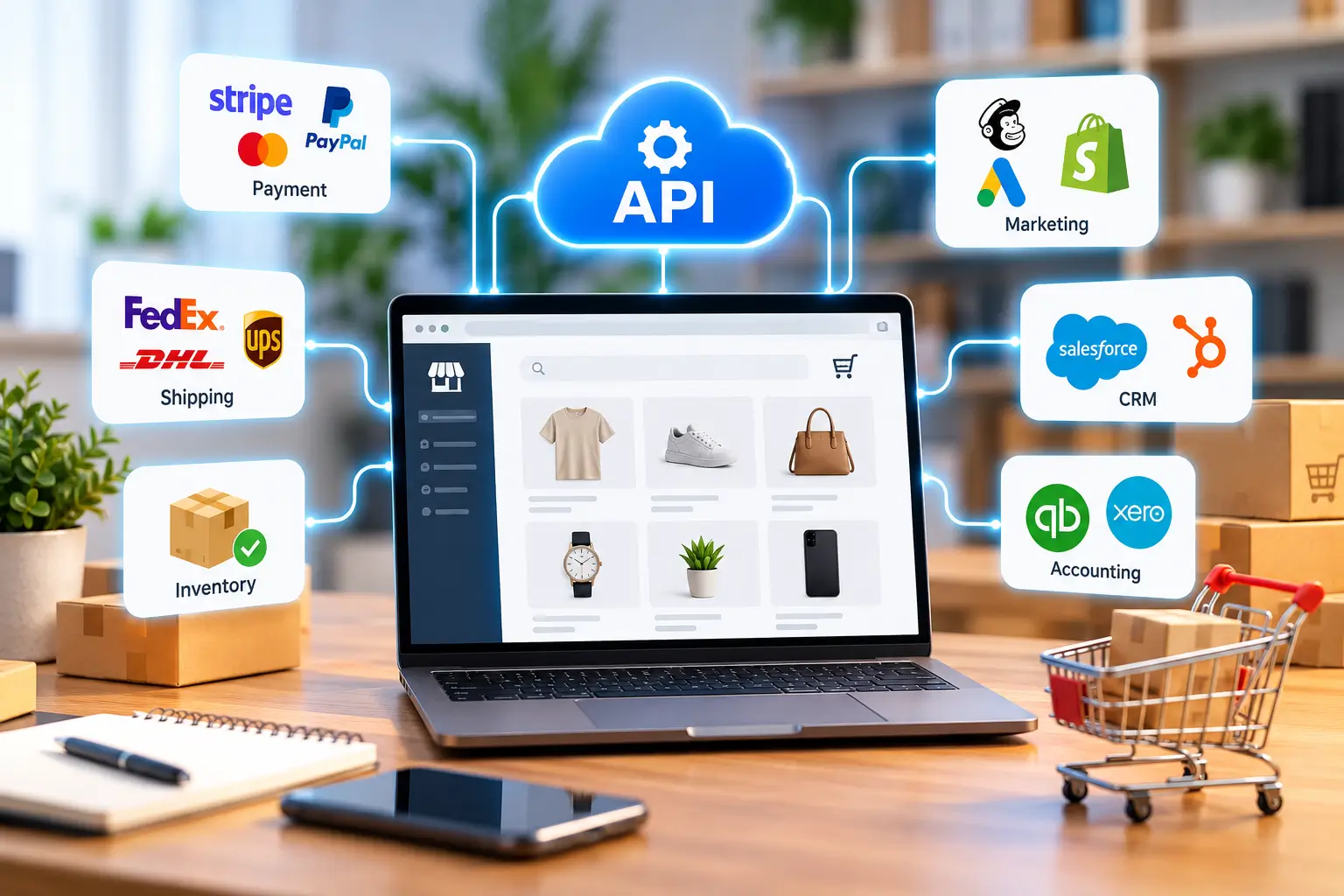
API integration for ecommerce connects your online store with external tools, payment gateways, shipping carriers, inventory systems, and marketing platforms, so data flows automatically between them instead of being entered manually. This saves time, reduces errors, and lets your store scale without adding extra administrative work for every new order. Businesses that integrate the right APIs typically see faster order processing, fewer stock mistakes, and a smoother overall customer experience.
Why This Matters as Your Store Grows
A small ecommerce store can survive on manual processes, updating inventory by hand, copying order details into a shipping tool, checking payments separately. That approach breaks down fast once order volume grows. How API integrations help ecommerce businesses run smarter comes down to one simple idea: letting your systems talk to each other automatically, instead of relying on someone doing it manually every single time.
This guide breaks down what API integration actually means, why it matters specifically for ecommerce, the most common integrations stores rely on, and how to know if your business needs better integration right now.
What Is API Integration in Simple Terms?
An API, short for application programming interface, is a way for two different software systems to communicate and share data automatically. API integration means connecting your ecommerce platform to another tool, a payment processor, a shipping carrier, an accounting system, so information passes between them without anyone manually transferring it.
Think of it like a messenger that constantly relays information back and forth. When a customer places an order, the API can automatically notify your shipping provider, update your inventory count, and sync the transaction with your accounting software, all within seconds, without a single manual step.
Why API Integrations Matter for Ecommerce Specifically
Ecommerce businesses rely on more moving parts than almost any other type of online business. A single order touches payment processing, inventory, shipping, customer communication, and often marketing automation, all at once. Without integration, each of these steps requires someone to manually check and update information across separate systems.
This matters even more as a store scales. What takes a few manual minutes per order at low volume becomes genuinely unmanageable once a store processes hundreds of orders daily. API integrations remove this bottleneck, letting the store’s systems handle the repetitive work automatically while your team focuses on growth rather than data entry.
Key Types of API Integrations Ecommerce Businesses Use
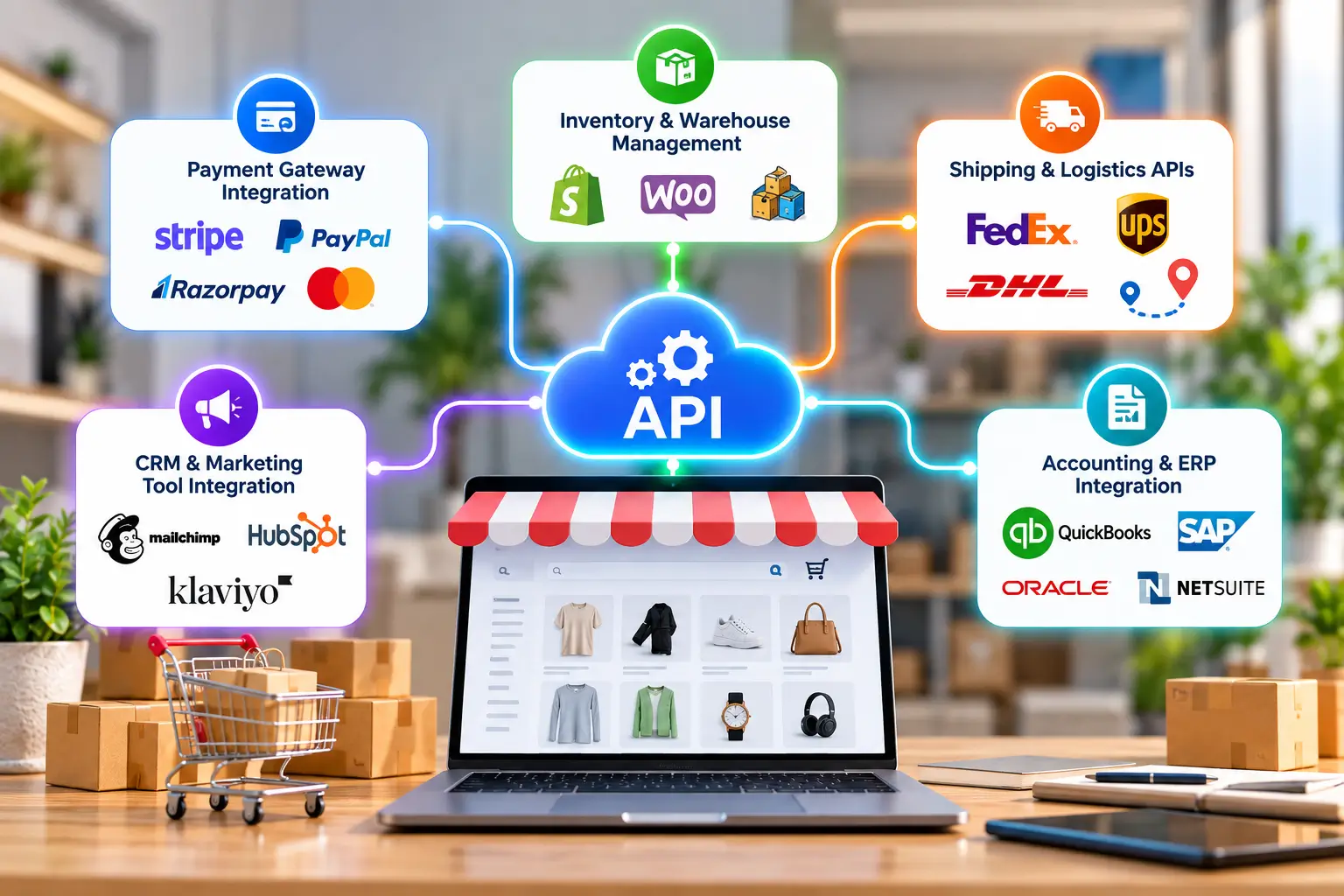
Different parts of an ecommerce operation benefit from different types of API integration, each solving a specific operational need.
Payment Gateway Integration
Payment gateway APIs connect your store directly to payment processors like Stripe, PayPal, or Razorpay, allowing transactions to process securely and instantly without redirecting customers through clunky, disconnected checkout flows.
Shipping and Logistics APIs
Shipping APIs connect your store to carriers like FedEx, UPS, or local delivery services, automatically generating shipping labels, calculating real-time rates, and updating tracking information without manual input from your team.
Inventory and Warehouse Management
Inventory APIs sync stock levels across your website, warehouse systems, and any additional sales channels in real time, preventing the common problem of overselling a product that is already out of stock.
CRM and Marketing Tool Integration
CRM and marketing APIs connect customer data from your store directly into tools like Mailchimp, HubSpot, or Klaviyo, enabling automated email flows, personalized offers, and accurate customer segmentation based on actual purchase behavior.
Accounting and ERP Integration
Accounting and ERP integrations automatically sync sales data, taxes, and financial records into systems like QuickBooks or an internal ERP platform, reducing manual bookkeeping and minimizing costly reporting errors.
Real Benefits API Integration Brings to an Online Store
The practical impact of good API integration shows up across nearly every part of running an ecommerce business.
- Faster order processing since payment, inventory, and shipping updates happen automatically instead of through manual steps
- Fewer costly errors, like overselling out-of-stock items or sending incorrect shipping information to customers
- Better customer experience, with real-time order tracking, accurate stock availability, and faster checkout
- Time saved for your team, freeing staff from repetitive data entry to focus on growth and customer service
- Easier scaling, since automated systems handle increased order volume without needing proportionally more manual labor
Together, these benefits compound over time. A store processing fifty orders a day might not notice much difference, but a store processing five hundred orders daily depends entirely on these integrations running smoothly in the background.
Common Challenges When Integrating APIs (and How to Avoid Them)

API integration brings real advantages, but it is not without its challenges, especially when planned or implemented poorly.
Data sync delays or mismatches can occur when two systems update information at different speeds, leading to temporary inconsistencies, like a product showing available stock that has actually sold out moments earlier. Using real-time or near-real-time sync methods, rather than batch updates on long delays, helps minimize this risk.
Security vulnerabilities are another real concern, since APIs handle sensitive data like payment details and customer information. Working with properly authenticated, encrypted API connections, and avoiding shortcuts during setup, significantly reduces this risk.
Compatibility issues can arise when connecting older systems with newer platforms, sometimes requiring custom middleware to bridge the gap. Planning integrations with this possibility in mind from the start avoids costly surprises mid-project.
Lack of ongoing maintenance causes many integrations to break silently over time, as third-party APIs update their own systems. Regular monitoring and scheduled maintenance checks catch these issues before they disrupt daily operations.
h2 style=”font-size: 28px; font-weight: 600;”>How to Know If Your Store Needs Better API Integration
A few clear signs typically indicate it is time to invest in better API integration. Your team might be spending significant time manually updating inventory, processing orders, or transferring data between systems that should already be connected. You may be experiencing frequent stock discrepancies, where the website shows a product as available when it has actually already sold out elsewhere.
Slow order fulfillment, delayed shipping updates, or customers frequently contacting support about order status are also strong indicators. If your store relies on multiple disconnected tools, a separate accounting system, a separate CRM, a separate shipping platform, without any of them communicating automatically, this is usually the clearest sign that better integration would meaningfully improve daily operations.
h2 style=”font-size: 28px; font-weight: 600;”>How AHA Technocrats Handles API Integration for Ecommerce Projects

AHA Technocrats builds and manages API integrations tailored specifically to how each ecommerce business actually operates, rather than applying a generic, one-size-fits-all setup. Our team starts by understanding your current tools and workflows, then identifies exactly which integrations will remove the most friction from your daily operations.
From payment gateways and shipping carriers to inventory systems and marketing platforms, we handle the technical setup, testing, and ongoing monitoring needed to keep these connections running reliably. This approach works alongside our broader ecommerce development services, ensuring your store’s backend operations run as smoothly as the storefront your customers see.
Frequently Asked Questions
What is the most important API integration for a new ecommerce store?
Payment gateway integration is usually the most critical starting point, since it directly affects your ability to process transactions securely and reliably from day one.
Does API integration slow down my website?
Properly implemented API integrations should not noticeably slow down your website, since most run in the background through efficient, asynchronous processes rather than blocking page load times.
Can I integrate multiple APIs into one ecommerce platform?
Yes, most modern ecommerce platforms support multiple simultaneous API integrations, allowing payment, shipping, inventory, and marketing tools to all work together within the same system.
How much does API integration typically cost?
Cost depends on the complexity of the integration and the number of systems involved, with simple integrations costing significantly less than custom, multi-system setups requiring ongoing maintenance.
Do I need a developer to set up API integrations?
Most ecommerce platforms offer basic integrations through built-in apps or plugins, but custom or complex integrations, especially those involving multiple systems, typically require a developer to implement correctly and securely.
Conclusion
API integration has become a genuine operational necessity for ecommerce businesses, not just a technical nice-to-have. Connecting payment, shipping, inventory, and marketing systems automatically removes manual work, reduces costly errors, and lets a store scale without adding proportional administrative overhead. AHA Technocrats helps ecommerce businesses identify and implement the right integrations for their specific tools and workflows, keeping daily operations running smoothly as the business grows.
