


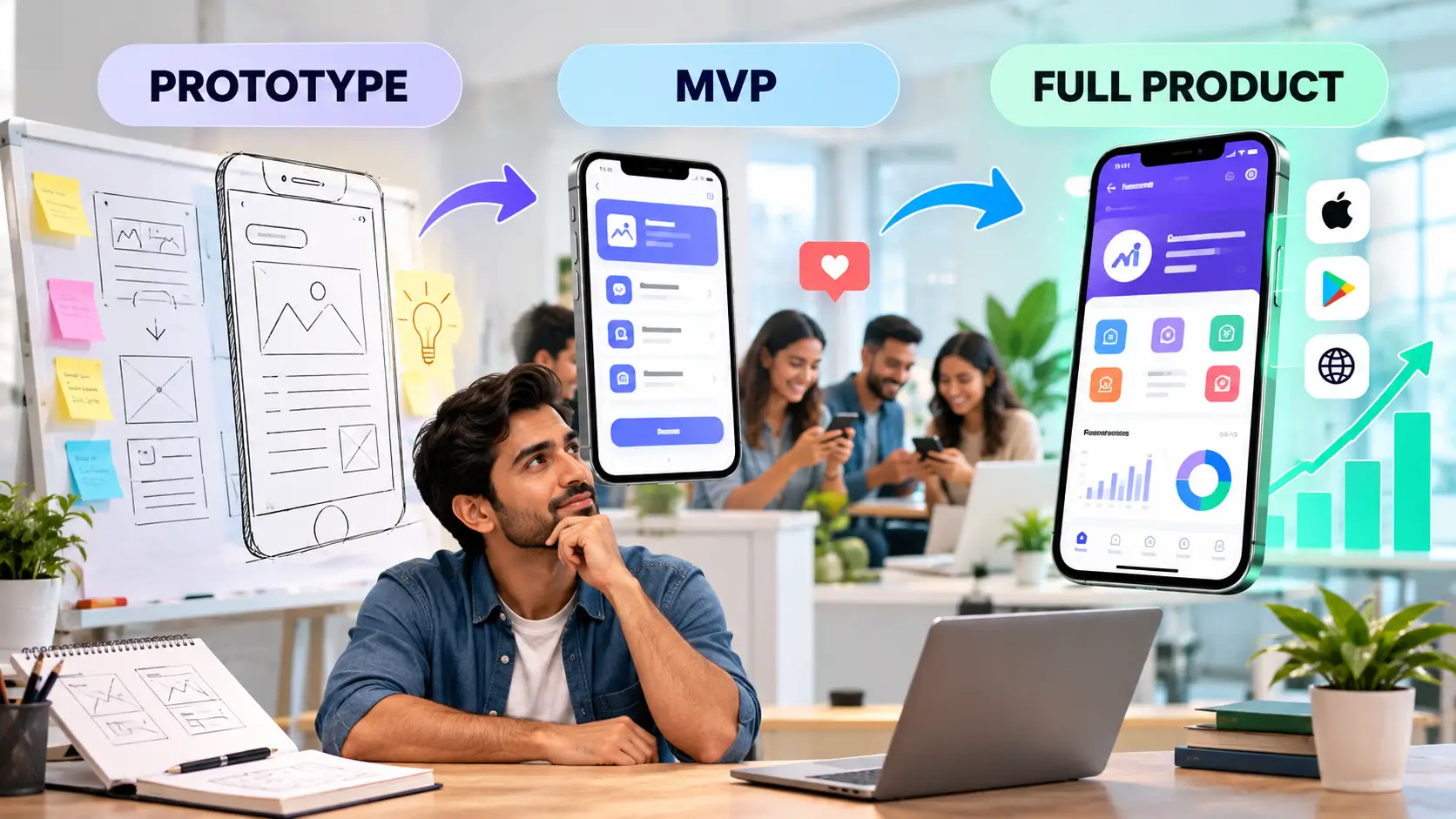
MVP vs prototype vs full product comes down to what question you are trying to answer right now. A prototype tests whether an idea looks and feels right, an MVP tests whether real users will actually use and pay for it, and a full product delivers the complete, polished experience once that demand is proven. Most startups waste budget by jumping straight to a full product before validating the idea at either of the earlier stages.
Why This Decision Costs Startups More Than They Expect
Many startups lose months and a significant chunk of their budget because they build the wrong thing at the wrong time. Some jump straight into a full product without ever testing whether users actually want it. Others stay stuck polishing a prototype for too long, afraid to put something real in front of paying customers.
MVP vs prototype vs full product is not just a technical distinction, it is a decision about risk, budget, and timing. This guide breaks down exactly what separates these three stages, and how to know which one your startup genuinely needs right now.
What Is a Prototype?

A prototype is an early, often non-functional representation of your product idea, used to demonstrate how it will look and how users will move through it. Prototypes can range from simple paper sketches to clickable digital mockups built in tools like Figma, but they generally do not involve real, working code behind the scenes.
The main purpose of a prototype is communication, showing investors, team members, or early testers what the product will look like before committing real development time and money. A prototype answers the question, does this idea make visual and logical sense, not whether people will actually use it.
What Is an MVP (Minimum Viable Product)?
An MVP, or minimum viable product, is a real, working version of your product built with only the core features needed to solve the main problem for early users. Unlike a prototype, an MVP is fully functional, users can genuinely sign up, use the product, and in many cases, pay for it.
The goal of an MVP is validation, testing whether real people actually want what you are building, before investing in every additional feature on your roadmap. A well-built MVP answers a much harder question than a prototype does: will people actually use this, and will they come back.
What Is a Full Product?
A full product is the complete, feature-rich version of your startup’s offering, built after you already have solid evidence that the core idea works. This stage typically includes advanced features, deeper customization, stronger infrastructure, and the kind of polish needed to compete seriously in the market.
Building a full product makes sense once your MVP has proven real demand, and you understand which features users actually value versus which ones were simply assumptions. Skipping straight to this stage without that validation is one of the most common and expensive mistakes startups make.
MVP vs Prototype vs Full Product: Key Differences
Understanding how these three stages differ across practical factors makes the right choice much clearer.
| Factor | Prototype | MVP | Full Product |
|---|---|---|---|
| Purpose | Show how the idea looks and flows | Test real user demand | Deliver the complete experience |
| Functionality | Little to none, often clickable only | Core features, fully working | All planned features, polished |
| Cost | Low | Moderate | High |
| Timeline | Days to a couple weeks | A few weeks to a couple months | Several months or more |
| Built For | Internal teams, investors, early feedback | Real early users or customers | The full target market |
Purpose
A prototype exists to communicate an idea visually. An MVP exists to test whether that idea actually solves a real problem for real users. A full product exists to serve the entire market with a complete, refined experience.
Development Cost
Prototypes cost the least, since they require little to no actual coding. MVPs cost more, since core functionality needs to be genuinely built and tested. Full products cost significantly more, given the scope of features, polish, and infrastructure required.
Timeline
A prototype can often be built within days using design tools. An MVP typically takes several weeks to a couple of months, depending on complexity. A full product can take several months or longer, especially as additional features and refinements get added over time.
Who It’s Built For
Prototypes are usually shown to internal teams, investors, or a small group of early testers for feedback. MVPs go out to real early users or customers willing to try an imperfect but functional product. Full products are built for the broader target market, expecting a polished, complete experience.
Level of Functionality
A prototype often fakes functionality just enough to demonstrate the flow, buttons may not actually work behind the scenes. An MVP includes genuinely working core features, even if some are basic. A full product includes the complete feature set, refined and tested across various use cases.
Why Startups Often Confuse These Three Stages

Confusion between these stages is common, and it usually comes from a few specific, recurring misunderstandings.
- Mistaking a polished prototype for a finished product – a clickable prototype can look impressive enough to feel ready for launch, leading founders to believe they are further along than they actually are, when in reality nothing has been tested with real users yet
- Using “MVP” and “prototype” as interchangeable terms – many founders use both words loosely in conversation, which blurs the real distinction between showing an idea and actually testing it with working functionality
- Feeling pressure to skip straight to a full product – some founders worry a basic MVP will look unprofessional to early customers or investors, pushing them toward building a complete product before anyone has confirmed the core idea works
- Overbuilding features based on assumptions – this pressure often leads to adding advanced functionality before any real user has asked for it, a far costlier mistake than launching something simple and iterating based on actual feedback
- Treating investor enthusiasm as market validation — positive reactions to a prototype or pitch deck can feel like proof of demand, but only real usage data from an MVP genuinely confirms whether people want the product.
Understanding these patterns early helps startups avoid the two most expensive mistakes in this process: launching too early without real validation, or building too much before anyone has confirmed it is worth building at all.
Which Stage Should You Start With?
There is no universal starting point that fits every startup. The right stage depends on how much you already know about your idea, whether you have tested it with real users yet, and how much budget you have available to validate before committing to a bigger build.
When a Prototype Is the Right First Step
Choose a prototype first if you still need to validate the basic concept internally, gather early investor interest, or simply are not yet sure how the product should look and flow. Prototypes are ideal when speed and low cost matter more than real functionality at this early stage.
When an MVP Makes More Sense
Choose an MVP once you have a clear idea of your core feature set and want genuine proof that real users will use, and ideally pay for, your product. This is the right stage when you are ready to test actual demand, not just visual design.
When You’re Actually Ready for a Full Product
Choose a full product build only after your MVP has shown real, validated demand, and you understand which features genuinely matter to your users. Building a full product too early, without this evidence, is one of the most expensive mistakes a startup can make.
Signs You’re Moving to the Next Stage Too Early
A few clear warning signs suggest you might be rushing ahead before you are ready. You might be adding features to your MVP that no user has actually asked for, based purely on assumptions about what they might want later. You may be investing in a full product build without having a meaningful number of real, active MVP users first.
Another common sign is treating investor interest in your prototype as proof of market demand, when in reality, only real user behavior with a working MVP can confirm that. Moving ahead based on excitement rather than evidence is one of the clearest signs a startup is skipping a stage it genuinely needs.
How AHA Technocrats Helps Startups Choose and Build the Right Stage

Deciding between MVP vs prototype vs full product does not have to be a guessing game. AHA Technocrats works closely with startups to understand their current stage, goals, and available budget, then recommends the right starting point, whether that means a quick prototype, a focused MVP, or a full product build once validation already exists.
Our team has helped startups move through each of these stages, building MVPs that genuinely test real demand and scaling successful ones into full products without wasted rework. Whichever stage fits your startup right now, we build it with the same focus on real business value, not just technical delivery.
Frequently Asked Questions
Can a prototype turn directly into an MVP?
Not usually. A prototype is typically built with design tools and lacks real, working code, so an MVP generally needs to be built from scratch using the insights gathered from the prototype, rather than evolving directly from it.
Do investors expect to see an MVP or a full product?
Most investors expect to see an MVP with some evidence of real user engagement, rather than a full product. A working MVP demonstrates both technical feasibility and genuine market interest, which carries more weight than a prototype alone.
How much does each stage typically cost?
Costs vary widely depending on complexity, but prototypes are generally the least expensive, MVPs cost more due to real development work, and full products cost the most given their complete feature set and polish.
Is it possible to skip the MVP stage entirely?
It is possible, but risky. Skipping directly from a prototype to a full product means committing significant budget before confirming real user demand, which increases the chance of building features or an entire product that users do not actually want.
Conclusion
MVP vs prototype vs full product is not just a matter of timing, it is a matter of risk. A prototype validates the idea visually, an MVP validates real demand with actual users, and a full product delivers the complete experience once that demand is proven. Startups that respect this order tend to spend their budget more wisely and build products people genuinely want. AHA Technocrats helps startups identify exactly which stage they are at, then builds the right solution for that stage, without the wasted cost of moving too fast or too slow.
