


On 21 October 2026, the PHP and Node.js projects each released security updates. PHP fixed two critical remote code execution (RCE) vulnerabilities. Node.js fixed ten flaws across its supported release lines. The two sets of bugs are unrelated, yet both affect server-side software that runs a large share of the web. This guide explains what happened, who faces risk, and how to patch.
What Happened on October 21, 2026?
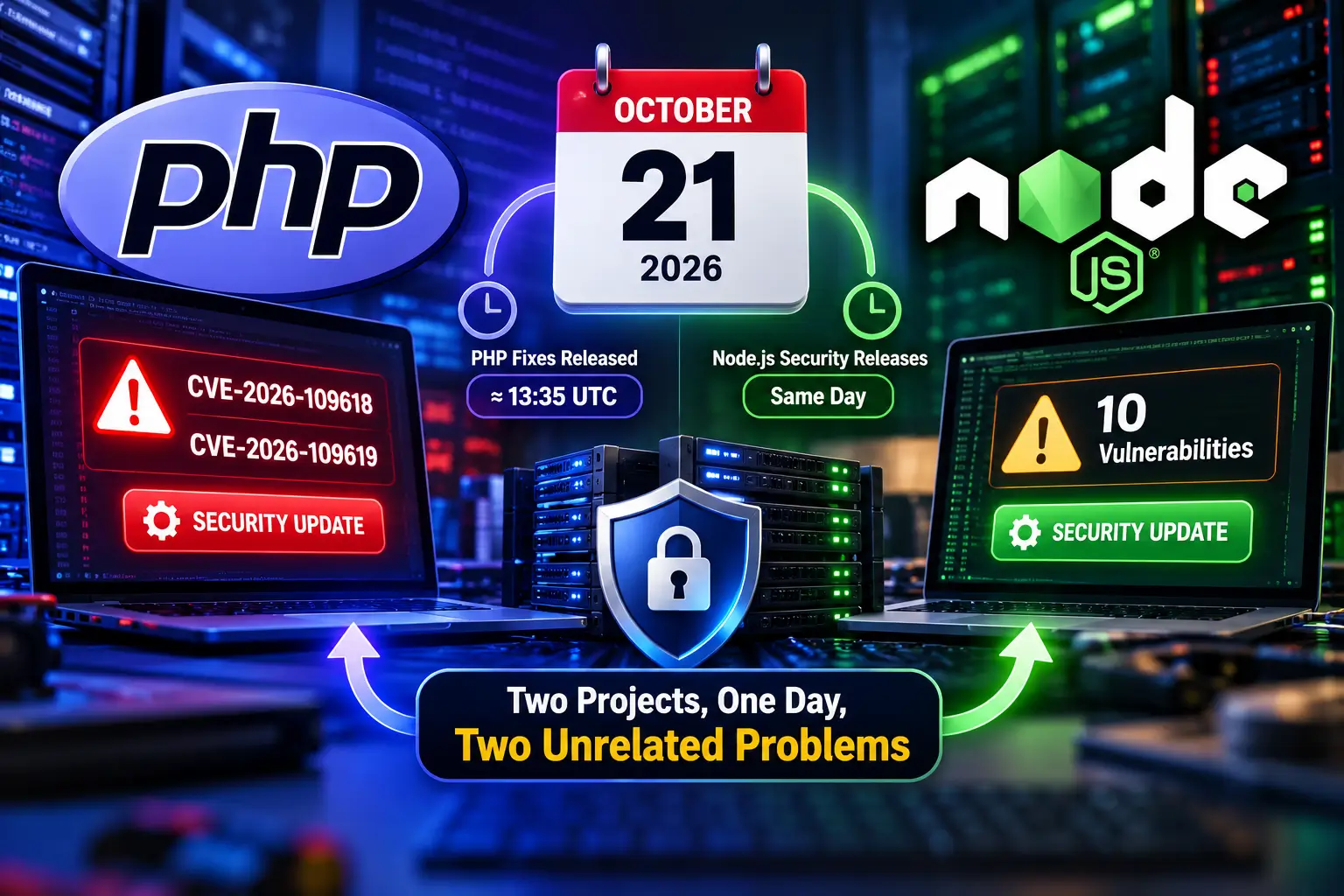
Two projects, one day, two unrelated problems
The overlap in timing caused confusion. Some social media posts linked the PHP flaws to the Node.js update, but they are separate issues in separate runtimes. Treat them as two patching jobs. If your stack uses both, you need to update both.
Critical PHP Vulnerabilities Explained
What Are the Newly Discovered PHP Vulnerabilities?
The PHP team fixed two bugs in the PHP core that can let an attacker run code on a server without logging in. The PHP team says all PHP installations serving web requests face risk. That covers PHP-FPM setups, Apache modules and similar web server configurations, whatever framework sits on top.
CVE-2026-109618: Remote Code Execution Through Memory Exhaustion Handling
PHP’s advisory calls this one “RCE via OOM corruption.” When PHP runs out of memory (OOM) during a request, the engine can stop while the request’s internal data is only partly initialized. Request cleanup may then treat that invalid data as valid, which an attacker can turn into code execution. The GitHub advisory ID is GHSA-w8hw-w9fx-j79w.
CVE-2026-109619: Risks From Stale Data Left in Memory
This flaw, titled “RCE via stale global state,” involves a use-after-free condition. Request-owned internal state can survive after PHP frees the memory behind it. A later request handled by the same worker may then use that stale state before normal initialization resets it. The GitHub advisory ID is GHSA-6wmf-4rv5-p3rp.
Both flaws exploit PHP’s memory handling rather than a mistake in any single website’s code. Clean application code therefore does not protect you.
Which PHP Versions Are Affected and Which Are Fixed?
Every release before the fixed versions is affected:
| PHP branch | Fixed release |
|---|---|
| 8.5 | 8.5.12 |
| 8.4 | 8.4.27 |
| 8.3 | 8.3.36 |
| 8.2 | 8.2.35 |
PHP 8.1 and older receive no regular patch release. Reports indicate the PHP team published minimal source-level backports for 7.4, 8.0 and 8.1, but those branches no longer have official security support. Plan an upgrade rather than relying on a backport. Also note that PHP 8.2 reaches end of life on 31 December 2026.
The scale of exposure is large. Security firm Mallory counted about 884,000 internet-facing hosts advertising PHP 8.1 or older on 20 October. That figure equals roughly 59% of the 1.5 million hosts that disclose their version.
Public Exploit Code and Why It Raises Urgency
Time matters here. Sophos reports that a proof-of-concept exploit is public, and watchTowr says it has observed exploitation in the wild. Attackers scan the internet for unpatched servers within hours of a disclosure like this. Update first, then investigate.
Node.js Security Vulnerabilities Disclosed in October 2026

The Node.js project fixed ten vulnerabilities on 21 October 2026: four rated high, three medium and three low. The fixes cover every supported release line (22.x, 24.x and 26.x). Four high-severity issues deserve attention first.
The Node.js Brotli Vulnerability
CVE-2026-111497 is an out-of-bounds write in the Brotli decoder, and Node.js says it permits remote code execution. The risk applies when your application decompresses Brotli data that someone else controls, such as request bodies sent to your server or responses from services you call. The upstream Brotli project also released fixed versions (1.2.1, 1.1.1 and 1.0.10). Node.js has not documented a workaround, so update the runtime.
DNS and TLS Certificate Validation Issues
Three more high-severity flaws affect how Node.js handles hostnames:
- CVE-2026-105482: The dns.resolve function cuts a name off at a NUL character. An attacker can slip past a hostname check that validated the full string, which helps them evade SSRF defences.
- CVE-2026-106069: TLS certificate checks can pass for the wrong host when the hostname loosely resolves to an IP address. This affects the 22.x, 24.x and 26.x lines.
- CVE-2026-105483: TLS hostname checks fail the same way when an IP address uses fullwidth digits. This affects only 24.x and 26.x.
These flaws matter most for outbound connections to addresses an attacker can influence, such as webhook URLs and link previews.
Other Vulnerabilities Addressed in the Security Release
The release also fixes medium-severity bugs, including a keep-alive socket issue (CVE-2026-105481), and low-severity Permission Model bypasses. Apply them with the same update.
Affected Node.js Versions and Security Updates
| Release line | Fixed version |
|---|---|
| Node.js 26 | 26.12.1 |
| Node.js 24 | 24.22.1 |
| Node.js 22 | 22.23.4 |
End-of-life lines, including Node.js 20 and older, receive no patch. The official Docker images updated on 21 October, so rebuild any image built earlier.
Are the PHP and Node.js Vulnerabilities Connected?
No. They live in different runtimes, have different root causes and carry different fixes.
Myth vs Fact
- Myth: The PHP flaws and the Node.js update are one coordinated attack.
- Fact: The two projects scheduled their releases independently, and the same-day timing is a coincidence.
- Myth: Patching PHP also protects Node.js.
- Fact: Each runtime needs its own update.
What Risks Do These Vulnerabilities Pose to Websites?

Successful remote code execution lets an attacker run commands on your server. From there, they can steal data, plant backdoors or pivot to other systems.
Who Is Most at Risk (WordPress, Laravel, APIs, legacy servers)
- WordPress and shared hosting: WordPress runs on PHP, so an unpatched host exposes every site on it.
- Laravel and other PHP frameworks: The flaws sit in PHP itself, so framework code offers no protection.
- APIs and backend services: Node.js applications that decode Brotli data or validate hostnames face the highest exposure.
- Legacy servers and containers: Forgotten machines and old base images often stay unpatched longest.
Potential Impact vs Confirmed Attacks
Distinguish risk from evidence. For PHP, watchTowr reports exploitation in the wild, and a public proof-of-concept exists. For Node.js, I found no reports of active exploitation, but check the advisory for updates.
How to Check Whether Your Website Is Affected
Check Your PHP Version
Run php -v on the server. The command-line version can differ from the one your web server uses, so also run php-fpm -v or check your container image. Any release below 8.5.12, 8.4.27, 8.3.36 or 8.2.35 needs an update.
Check Your Node.js Version
Run node -v. Below 22.23.4, 24.22.1 or 26.12.1, you need an update.
Identify the Runtime Used in Production
Your shell may show a different version from the one your services run. Version managers such as nvm or fnm often cause this mismatch. Inspect the running processes, your systemd units and your container images.
How to Fix the PHP and Node.js Vulnerabilities
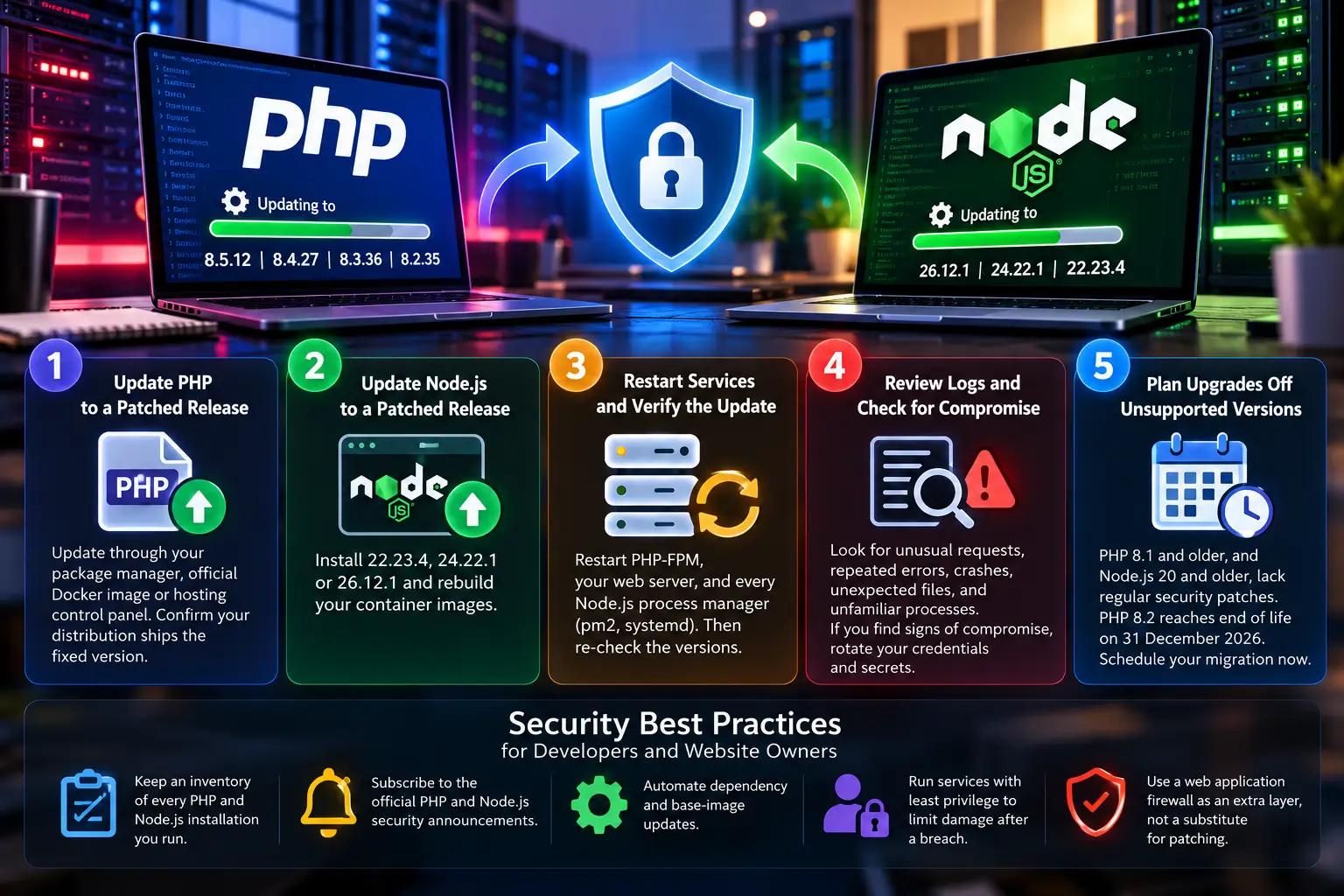
Update PHP to a Patched Release
Update through your package manager, the official Docker image or your host’s control panel. Some Linux distributions lag behind PHP’s release, so confirm your distribution actually ships the fixed version. PHP states that no complete mitigation exists, and hardening settings only reduce risk.
Update Node.js to a Patched Release
Install 22.23.4, 24.22.1 or 26.12.1, and rebuild your container images.
Restart Services and Verify the Update
Restart PHP-FPM, your web server, and every Node.js process manager (pm2, systemd). A patched binary on disk does not help while the old process keeps running. Then re-check the versions.
Review Logs and Check for Signs of Compromise
Look for unusual requests, repeated out-of-memory errors, crashes, unexpected files such as web shells, and unfamiliar processes. If you find signs of compromise, rotate your credentials and secrets.
Plan Upgrades Off Unsupported Versions
PHP 8.1 and older, and Node.js 20 and older, lack regular security patches. PHP 8.2 reaches end of life on 31 December 2026. Schedule your migration now.
Security Best Practices for Developers and Website Owners
- Keep an inventory of every PHP and Node.js installation you run.
- Subscribe to the official PHP and Node.js security announcements.
- Automate dependency and base-image updates.
- Run services with least privilege to limit damage after a breach.
- Treat a web application firewall as an extra layer, not a substitute for patching.
Frequently Asked Questions
Are the October 2026 PHP vulnerabilities critical?
Yes. Both score 9.2 on CVSS v4.0.
Can these vulnerabilities allow remote code execution?
Yes. The PHP flaws allow unauthenticated RCE, and the Node.js Brotli flaw permits RCE according to Node.js.
Which PHP versions should I update?
Move to 8.5.12, 8.4.27, 8.3.36 or 8.2.35, matching your branch.
Which Node.js versions contain the fixes?
22.23.4, 24.22.1 and 26.12.1.
Is updating PHP or Node.js enough to secure a website?
Updating closes these specific flaws. Also restart services, rebuild containers and check logs for earlier compromise.
Can WordPress websites be affected?
Yes. WordPress runs on PHP, so an unpatched PHP server exposes it.
Conclusion:Why Prompt Security Updates Matter
The 21 October releases show how fast the window closes between disclosure and exploitation. Update PHP and Node.js separately, restart every service, and verify the result. Then retire unsupported versions.
