


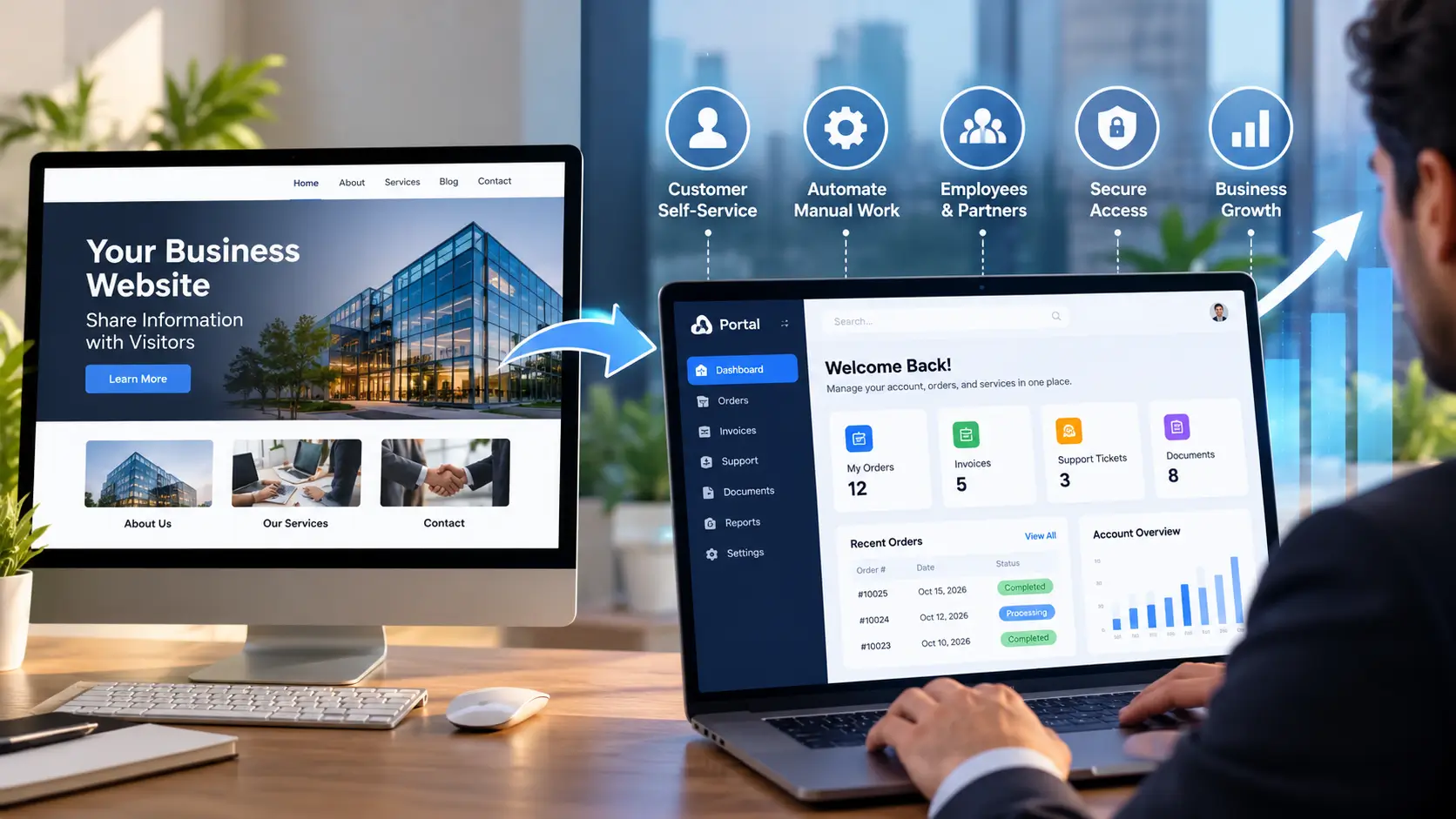
Growing businesses choose custom web portal development because a website only shares information, while a web portal lets users log in, see their own data, and finish tasks without calling your team. A portal cuts manual work, gives customers self-service, and keeps business data in one secure place. A website still works well for marketing, but a portal works better for daily operations.
Why This Choice Matters More Than It Seems
Many businesses start with a quick, off-the-shelf chatbot to test the waters, only to realize months later that it cannot handle their actual customer questions, cannot connect to their CRM, or sounds nothing like their brand. Off-the-shelf vs customized AI chatbots is not just a pricing decision, it shapes how useful the chatbot actually becomes once real customers start using it daily.
This guide breaks down what separates these two approaches, what a truly customized chatbot includes, and how to know which one genuinely fits your business right now.
What Is a Web Portal, and How Is It Different From a Website?
A web portal is a secure online platform where users log in to reach personalized information, tools, and services in one place. A website, by contrast, is a public space that shows the same content to every visitor.
Think of a website as a shop window and a web portal as the back office with a customer account. Visitors browse the window. Portal users sign in, check order status, download invoices, submit requests, and track progress. Every user sees only what applies to them, thanks to user authentication and role-based access control.
Custom web portal development takes this idea further. Instead of using a generic template, developers build the portal around your workflows, your data, and your user roles.
Website vs Web Portal: Key Differences
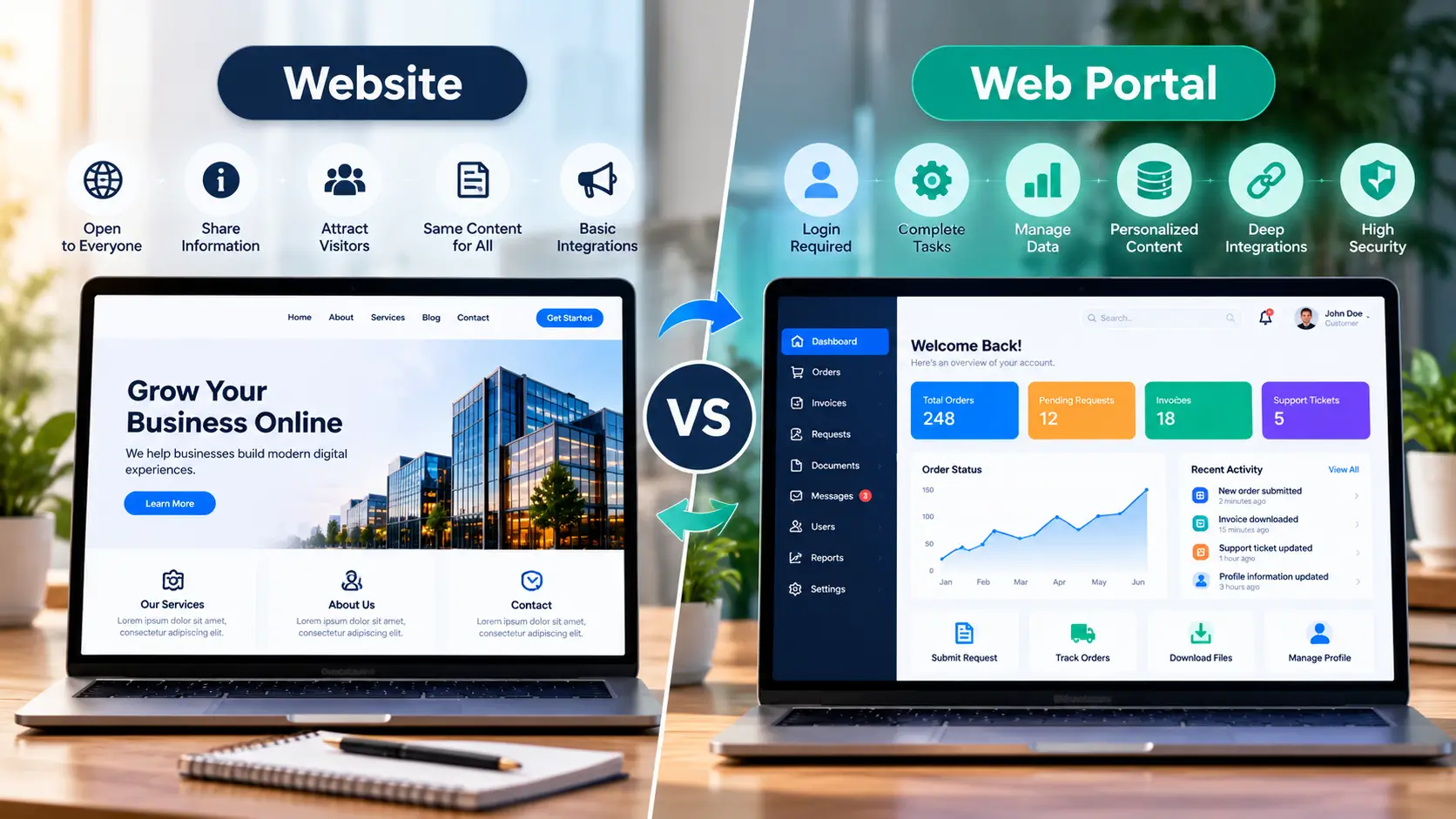
This table shows how the two compare on the factors that matter most to growing businesses.
| Factor | Website | Web Portal |
|---|---|---|
| Main purpose | Share information and attract visitors | Let users complete tasks and manage data |
| Access | Open to everyone | Login required |
| Personalization | Same content for all visitors | Content tailored to each user or role |
| User actions | Read, browse, fill contact forms | Submit requests, track orders, download files |
| Data handling | Mostly static content | Live, user-specific data and dashboards |
| Integrations | Basic, such as analytics and forms | Deep CRM, ERP, and API integration |
| Security | Standard protection | Authentication, permissions, and audit trails |
Many businesses run both. The website attracts new visitors, and the portal serves the people who already do business with you.
Why Growing Businesses Are Outgrowing Their Websites
Growth adds customers, staff, and data. A website that worked for 20 clients often struggles at 200. Four problems appear most often, and each one points toward web portal development.
Manual Work Slows Teams Down
Teams spend hours answering status emails, entering data by hand, and chasing approvals. A portal handles these steps through workflow automation, so your staff can focus on work that needs a human.
Customers Expect Self-Service
Customers now expect to check orders, update details, and raise tickets at any hour. A self-service portal gives them that access around the clock, which lowers your support load and raises satisfaction.
Data Sits in Too Many Places
Sales data sits in the CRM, invoices sit in accounting software, and files sit in email threads. A portal connects these systems through API integration, including CRM and ERP integration, and shows users one clear dashboard.
Access and Security Needs Have Grown
As more people touch sensitive data, simple passwords stop being enough. Portals add single sign-on, role-based permissions, and activity logs, which support data security and compliance.
Types of Custom Web Portals Businesses Build
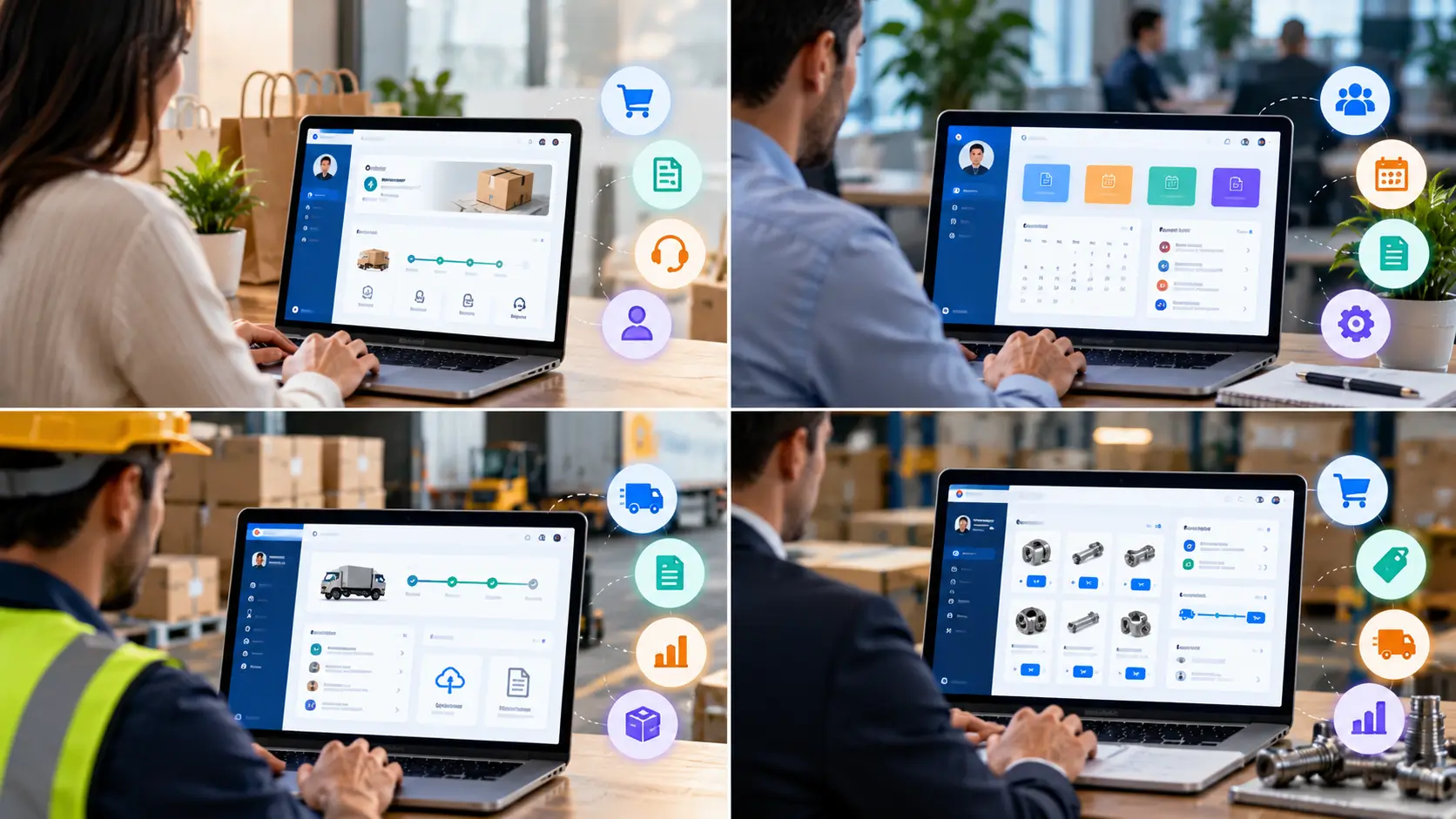
The right portal depends on who needs access. Most types of web portals fall into four groups, and each one solves a different problem.
Customer Portals
Customer portal development gives your clients a private space to view orders, download invoices, raise support tickets, and update account details. Customers get answers without calling your team, and your staff spend less time on routine requests.
Employee Portals
Employee portal development puts HR documents, internal tools, leave requests, and company updates in one login. New hires find what they need faster, and managers approve requests without long email chains.
Vendor and Partner Portals
Vendor portal development helps you manage suppliers and partners in one place. They can upload documents, check payment status, and share delivery updates, while you keep full visibility over every transaction.
B2B Ordering Portals
A B2B portal lets business buyers place repeat orders, see custom pricing, track shipments, and reorder in a few clicks. Wholesalers and manufacturers often see the biggest time savings here, since orders no longer arrive by phone or email.
Key Features of a Custom Web Portal
Strong web portal development focuses on features that remove daily friction. These are the ones that matter most:
- User authentication and single sign-on (SSO): Users log in once and reach every connected tool safely
- Role-based access control: Each person sees only the data and actions their role allows
- Dashboard and reporting: Users upload, store, and download files in a secure, organized space
- Workflow automation: Requests, approvals, and notifications move forward without manual follow-ups
- API integration: The portal connects to your CRM, ERP, payment tools, and other systems
- Personalized user experience: Content, menus, and data change based on who is logged in
- Scalable architecture:The portal keeps working smoothly as users and data grow
A good build also includes data security and compliance measures, such as encryption, audit trails, and regular backups.
Signs Your Business Is Ready for a Web Portal
You may be ready for web portal development if several of these sound familiar:
- Your team answers the same status and account questions every day.
- Customers or partners ask for a login to check orders, invoices, or documents.
- Data lives in spreadsheets, email threads, and separate tools that do not talk to each other.
- Approvals and requests stall because someone has to forward them by hand.
- You need to control who can see sensitive files or pricing.
- Your current website cannot support the number of users you now serve.
If three or more apply, a portal will likely save you time and money within the first year of use.
When a Regular Website Is Still Enough
A portal is not the right answer for every business. Be honest about where you stand before you invest.
A regular website still works well when you mainly want to attract new visitors, share services, publish content, and collect enquiries. If you have few repeat customers, no login needs, and simple processes, a strong website with a contact form does the job at a lower cost.
The web portal vs website decision comes down to one question: do your users need to act on their own data, or only read about your business? If they only read, keep the website. If they act, plan a portal.
What Affects Web Portal Development Cost and Timeline?
Web portal development cost depends on scope, not on a fixed price. These factors have the biggest effect:
- Number of user roles: More roles mean more permissions and screens to build
- Feature depth: A simple login with a dashboard costs less than a portal with automation, reporting, and document management
- Integrations: Connecting to CRM, ERP, or payment systems adds development and testing time
- Design and branding: A fully custom interface takes longer than a template-based layout
- Security and compliance needs: Industries like healthcare and finance require extra safeguards
- Ongoing support: Maintenance, updates, and hosting add to long-term cost
Timelines follow the same pattern. A basic portal can launch in a few weeks, while a complex, multi-role portal with deep integrations often takes several months. Starting with a focused first release, then adding features later, keeps both cost and risk under control.
How AHA Technocrats Builds Custom Web Portals
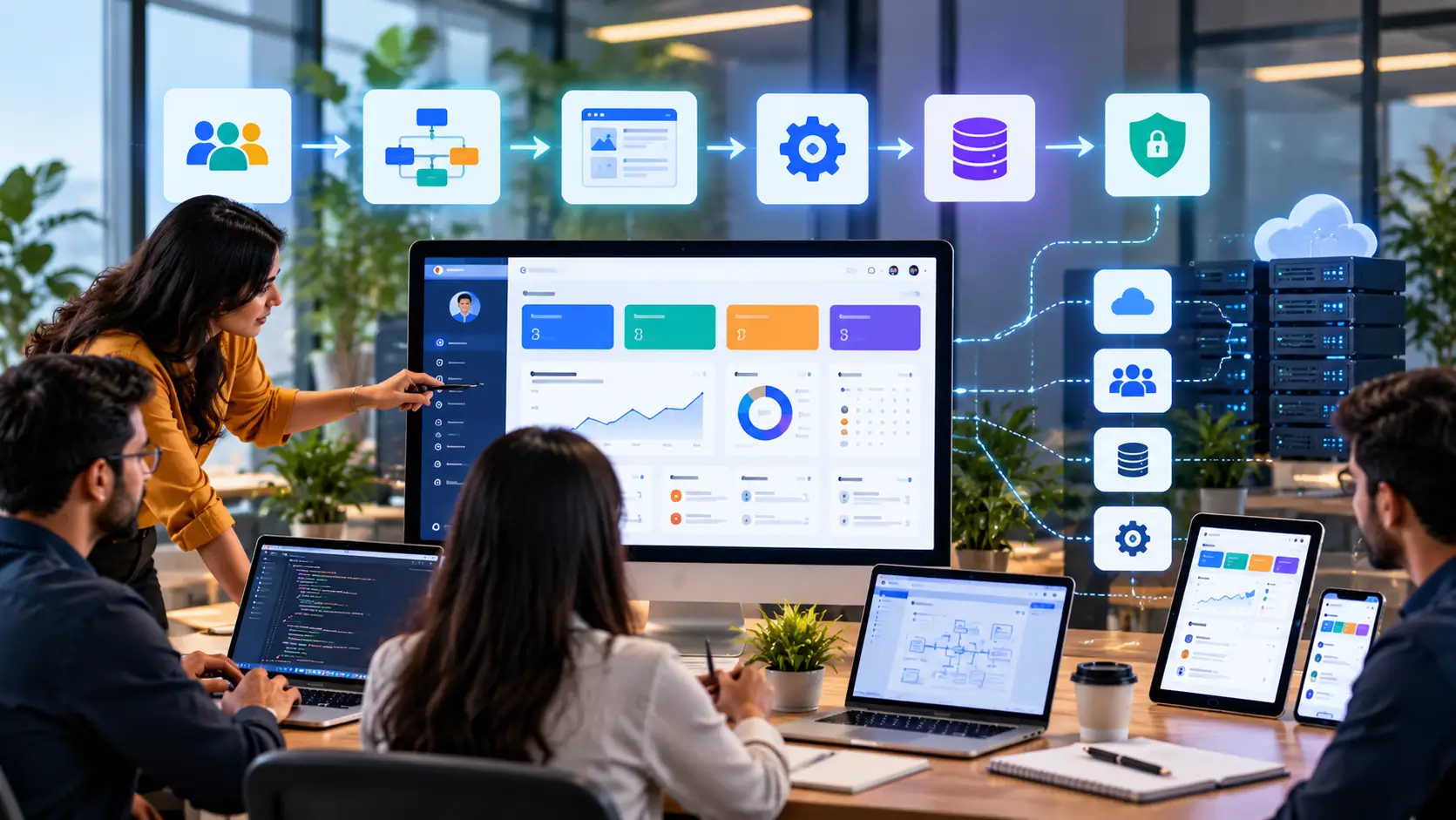
AHA Technocrats provides web portal development services built around how your business actually works. We begin by mapping your users, workflows, and existing tools, then design a portal that removes your biggest manual bottlenecks first.
Our team handles custom web portal development from planning to launch, including secure login, role-based permissions, API integration with your CRM and ERP, and a clean dashboard your users enjoy. This work sits alongside our broader web development services and custom software development, so your portal, website, and internal systems stay connected. If you want a web portal development company that builds for growth, we are ready to talk through your project.
Frequently Asked Questions
What is the difference between a website and a web portal?
A website shares public information with every visitor, while a web portal requires login and shows personalized data and tools to each user. A portal lets people act, such as tracking orders or submitting requests, instead of only reading.
How much does it cost to build a web portal?
Cost varies with the number of user roles, features, integrations, and security needs. A simple portal costs far less than a multi-role system with deep CRM and ERP integration, so a scoped quote after a short discovery call gives the most accurate number.
How long does web portal development take?
A basic portal can take a few weeks, and a complex one can take several months. Starting with a focused first version and adding features in later phases usually gets you live faster.
Can a web portal integrate with my CRM or ERP?
Yes, most portals connect to CRM, ERP, accounting, and payment tools through API integration. This keeps data in sync, so users always see current information without manual updates.
Is a web portal secure enough for sensitive business data?
Yes, when it is built correctly. Features like single sign-on, role-based access control, encryption, and audit trails protect sensitive data, and regular updates keep the portal secure over time.
Conclusion
Growing businesses move from websites to custom portals because daily operations need more than a place to publish information. Web portal development gives customers self-service, gives teams automation, and keeps your data secure in one connected system. A regular website still suits simple needs, but once your users need to log in and get things done, a portal pays for itself in saved time and happier customers.
AHA Technocrats builds portals that fit your workflows, connect with your existing tools, and scale with your growth. If you are ready to plan your portal, contact our team for a free consultation and a clear roadmap.
